


What’s old is new again: VW developed auto start/stop, DI in 1980
link – Autoblog Green
link – Popular Science
The great risk in predicting the future is that the odds are great that you will be wrong. Every once in while, though, you nail the ideas almost dead on. For some amusement, it’s always fun to go back and peruse old issues of magazines like Popular Science and Popular Mechanics to see what they predicted cars would look like in the next century (that would be the one we live in right now).
Way back in 1980, Volkswagen built a Golf-sized experimental car dubbed VW2000. The timing was off by a few years, but the good bits were remarkably close to where we are today. The VW2000 had a prototype automatic start stop system which is becoming increasingly common today. Unlike today’s systems that mainly rely on a heavy duty conventional starter or integrated starter/generator, this concept used a flywheel based system.
The system adds a second clutch between the engine and flywheel in addition to the conventional unit between the clutch and gearbox. The new clutch would disengage when the car came to a stop, allowing the flywheel to continue spinning while the engine was off. Re-engaging the clutch would allow the flywheel to restart the engine. It’s an interesting idea that we’ll have to look into to see why it was never adopted. Another of the idea in the VW2000 was the adoption of direct injection for the diesel engine. That, of course, is pretty much universal now in diesels and rapidly becoming ubiquitous in gas engines too. Check out the full story in Google books where all many old issues of Popular Science have been scanned.
Angelini Design and Volkswagen
Volkswagen AUTO2000 – 1980 – Prototipo finalizzato alla ricerca di nuove tecnologie e all’ottimizzazione del coefficiente aerodinamico. La linea della carrozzeria ha poi dato origine alla PASSAT, presentata nel 1988.
Prototype oriented toward the research of new technologies and aerodynamic optimization. This design paved the way for the PASSAT in 1988.
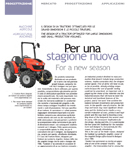 Per una nuova stagione – Plast Design 03-2012
For a new season – Plast Design 03-2012
< download article >
Un prodotto industriale destinato ad una produzione in serie che non prevede grandi tirature, comporta vincoli che il designer non può ignorare. Innanzitutto si dovrà utilizzare, per quanto possibile, componentistica già esistente perché il costo di attrezzature specifiche non potrebbe essere ammortizzato. Un ruolo importante riveste la scelta dei materiali e del processo industriale che dovranno soddisfare le caratteristiche tecniche e funzionali del progetto e allo stesso tempo coniugare l’equilibrio tra investimenti e costi di produzione.
An industrial product destined to mass production that doesn’t include large production volumes, implies constraints that the designer cannot ignore. First of all he will have to use, as far as possible, already existing components because the cost of specific tooling could not be amortized. An important role is played by the choice of the materials and the industrial process that will have to meet the technical and functional features of the project, and at the same time combine the balance between investments and production costs.
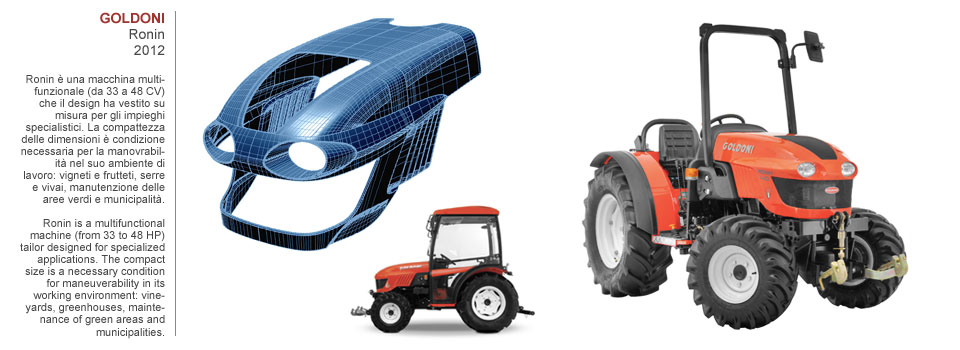
Goldoni presenta Ronin – Agritecnica 2012
Lamberto Angelini, Andrea Goldoni
Goldoni – www.goldoni.it – presenta Ronin, una macchina multifunzionale con potenze da 33 a 48 CV che il design ha vestito su misura per gli impieghi specialistici cui è destinata. La compattezza delle dimensioni è condizione necessaria per la manovrabilità nel suo ambiente di lavoro: filari di vigneti e frutteti, serre e vivai, manutenzione delle aree verdi e municipalità.
Goldoni unveils Ronin, a multifunctional machine with a power ranging from 33 to 48 HP tailor designed for specialized applications where the machine is intended. The compact size is a necessary condition for maneuverability in its working environment: vineyards, greenhouses, maintenance of green areas and municipalities.

Provocazione MONOPOSTO Ferrari / PESCE D’APRILE 
in collaborazione con Auto.it
Dopo la Ferrari FF, la prima 4×4 di Maranello, la Casa del Cavallino Rampante potrebbe ampliare la gamma.
Il concept MONOPOSTO è un’inedita mono-posto urbana.
Il massimo dell’edonismo. Non potrebbe essere diversamente, coerente col blasone della Casa.
Lunga 3 metri circa – un posto secco a guida centrale – motore in posizione posteriore – scocca portante in materiali compositi concepita come gabbia di sopravvivenza ad alta resistenza, rigidità e leggerezza.
Right after the Ferrari FF, the very first all wheel drive from Maranello, the prancing horse may widen the range. It’s about the the ultimate single-seat urban vehicle, the MONOPOSTO concept.
Hedonism at its best. And it couldn’t be otherwise, consistently with Ferrari factory identity.
The composite material safety frame gives the monocoque high resistance and stiffness, keeping the car very light.
It’s 3 meters long, it has ONE central driving seat, the engine is in the middle and the traction goes to the back. Expectedly there will be a powered-up version with a kinetic energy recovery system feeding electric motors inside the front wheels, so virtually awd.
All of that for unexperienced driving dynamics, which you will enjoy alone with yourself.
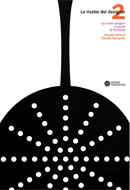
Le ricette dei designer 2
Le ricette dei designer – Ricetta Angelini
Recensione – Il Venerdì di Repubblica
Dopo il successo del primo volume “Le ricette dei designer. 70 progetti in punta di forchetta”, Premio Selezione Bancarella della Cucina 2010, 130 designer si mettono nuovamente in gioco, svelandosi nelle loro ricette preferite e raccontandole graficamente. Dallo street food alle ricette più elaborate, passando attraverso soluzioni improvvisate e nate per caso, il libro svela i segreti dei grandi progettisti attraverso il loro rapporto con il cibo e la cucina, nuovo e costante territorio di esplorazione. Per scoprire che piatti e prodotti di design hanno una radice comune, non solo nella mente di chi li progetta. Con introduzione a cura di Davide Rampello.